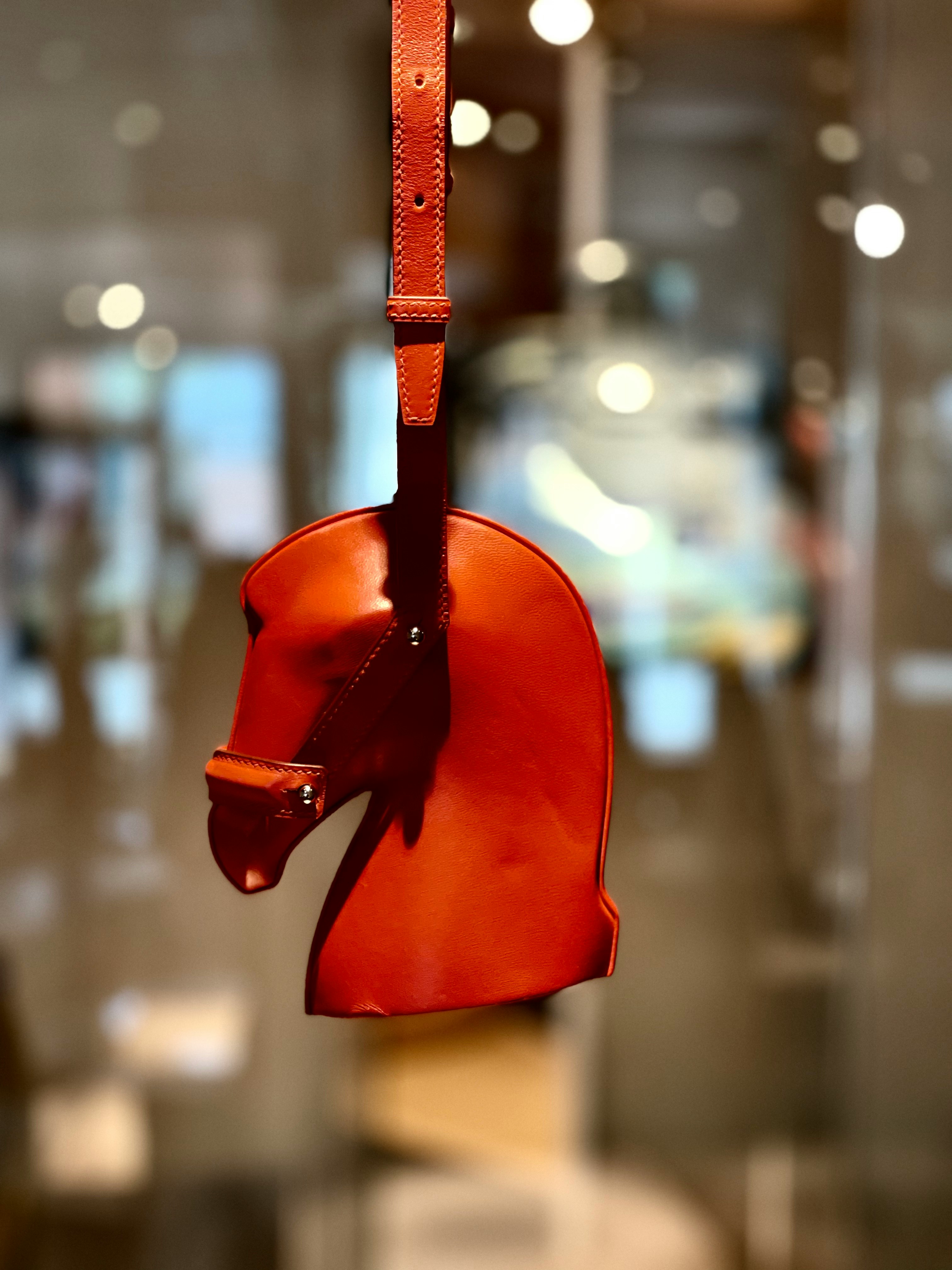
ホースヘッド(チェヴァル)
A leather accessory shaped as a horse head — an iconic form rooted in Hermès's equestrian heritage; vintage pieces are highly collectible.
- Common name
- Horse Head / Cheval (French for “horse”)
- Category
- Small good (bag charm / key holder)
- Representative series
- Paddock Cheval
- Main materials
- Leather (said to include Vache Hunter, Milo, Swift)
- Hardware
- Gold- or silver-tone clip and ring
- Representative colors
- Bleu Agate, Rose Sakura, and others (multiple colors)
- Origin of motif
- Founding as a harness/saddlery workshop (said to be 1837)
- Use
- Bag charm or key holder
- Launch year
- Varies by source (not asserted here)
- Approx. market
- Varies by condition/color/rarity (estimate, not guaranteed)
- Discernment points
- Leather quality, coba, stitching, hardware, stamp, accessories together
- On authenticity
- Guidance only, not a guarantee; final judgment by specialists
Price trend
Estimate only — not a guarantee—
Related videos
In depth
Overview — What the Horse Head (Cheval) Is
“Horse head” and “Cheval” (French for horse) are nicknames for Hermès leather accessories shaped as a horse's head or full body. These are small pieces that work both as a bag charm and as a key holder, and the motif is regarded as a symbol of Hermès' beginnings as a harness and saddle workshop. A well-known modern example is the “Paddock Cheval” charm, built up from cut leather pieces, blending a playful feel with refined leatherwork. Note that other “horse” pieces exist as well—such as fully three-dimensional metal horse key chains—so it helps to distinguish the families by material and form.
Original schematic illustration — not a photo of the actual item.
History & Origins — Echoes of the Harness Workshop
Hermès traces its origins to 1837, when Thierry Hermès founded a harness and saddlery workshop in Paris. Equestrian motifs flow directly from this heritage, and small pieces shaped like a horse's head or body neatly capture the house's identity. The leather “Paddock” charm series miniaturizes the props of the riding world—jockey caps, riding boots, saddles, horseshoes and horse heads—and is positioned as a homage to those early days of saddle-making. Specific launch dates vary across sources, so this page does not state a definitive year.
Materials — Leather Types and Texture
Leather horse heads / Paddock Cheval charms are said to use signature Hermès leathers such as Vache Hunter (a firm embossed calf), Milo (a textured lambskin) and Swift (a fine-grained, vividly coloring calf). Because the object is small and three-dimensional, the appeal lies in how multiple leather parts are cut and assembled, with stitching and lamination shaping the horse's expression. Leather and color combinations vary by piece, and on vintage examples the patina and deepening of color over time add to the charm. Identifying the material is best done by weighing appearance, stamps and accompanying items together, with final calls left to specialists.
Original schematic illustration — not a photo of the actual item.
Original schematic illustration — not a photo of the actual item.
Colors — Representative Shades
Being a leather charm, it has appeared in the rich palette typical of Hermès. Examples seen on the market include Bleu Agate (a clear pale blue), Rose Sakura (soft pink), Rose Jaipur, Bleu Electric, reds such as Capucines, brown, orange and gold. Because the same motif reads very differently by color, this is a strong point for collectors. The color names and approximate swatches shown here are for reference only; actual appearance varies with the specific item and lighting.
Construction & Details — Hardware and Build
To work as a bag charm or key holder, the piece typically has a leather strap or ring at the top with a metal clip (lobster or spring hook). Hardware is seen in gold-tone and silver-tone finishes. The body is assembled three-dimensionally from leather, with the mane and the contours of the face rendered through separate parts and stitching. Even at this small scale, the quality shows in the edge-paint (coba) finish and the evenness of the stitching. Specifications differ by era and by piece, so confirm the attachment type (charm vs. key ring) and hardware color on each individual item.
- 1Head (face) — Main body shaped as the horse's face, sculpted in smooth leather.
- 2Mane — Mane rendered as braided leather or leather fringe, often in a contrasting color.
- 3Ears — Pair of upright ears at the crown; prone to bending or losing shape.
- 4Contrast strap / headstall — Contrasting leather strap across the face, evoking an equestrian headstall.
- 5Attachment ring / lanyard — Leather loop with metal ring for attaching to a bag, similar to a clochette.
- 6Edge paint (coba) — Painted finishing along cut leather edges; peeling or cracking indicates condition.
Original schematic illustration — not a photo of the actual item.
Original schematic illustration — not a photo of the actual item.
Stamps & Dating (General Knowledge)
Hermès leather goods are known to carry a blind stamp indicating the year of manufacture and the artisan. As general guidance, the system is said to have evolved roughly as follows: a single letter without a circle around 1945–1970; a letter inside a circle around 1971–1996; a letter inside a square around 1997–2014; and from 2015 a new format combining letters and numbers. However, small goods and charms may differ from bags in whether and where a stamp appears, so dating or judging authenticity from the stamp alone is not appropriate. Treat the stamp as one supporting clue and leave the overall judgment to specialists.
General guide; a stamp alone does not prove year or authenticity.
Points to Check — Condition and Discernment
When buying pre-owned, assess holistically: (1) the leather's luster, dryness or cracking; (2) flaking of the edge-paint (coba); (3) loose or faded stitching; (4) plating wear, rust or function of the hardware; (5) the presence and manner of the stamp; and (6) accessories such as the box and dust bag. Being three-dimensional, it is prone to losing shape and to corner abrasion, and condition directly affects price. The points above are only guidance for checking condition and do not guarantee authenticity. This site does not perform appraisals; always consult specialists or a trusted retailer for any final decision on authenticity or purchase.
- ✓Edge-paint peeling / cracks — Check the painted edges for peeling or cracking; small charms abrade easily.
- ✓Mane / fringe condition — Inspect braids or fringe for fraying, missing strands, or color transfer.
- ✓Shape of ears / 3D parts — Look for bent or crushed ears and whether the original three-dimensional shape remains.
- ✓Metal ring condition — Check the attachment ring for plating loss, distortion, or a loose closure.
- ✓Drying / color fading — Assess the smooth leather for dryness or cracks and the contrast leather for fading or sun damage.
- ✓Stamp presence / legibility — Whether a maker's stamp is present and legible; treat as a condition reference only, not an authenticity guarantee (a personal view, not a guarantee).
Reference points only — not a guarantee of authenticity; consult a specialist.
Market & How to Choose
Leather horse heads / Paddock Cheval charms are considered hard-to-find small goods, and the market shows examples trading from the tens of thousands of yen upward, more depending on condition, color and rarity. Separate, rarer pieces such as a three-dimensional metal horse key chain have been offered overseas around USD 1,900 (all figures are estimates and do not guarantee any transaction price). A practical approach is to first decide on attachment type (charm vs. key ring) and color preference, then narrow by condition and accessories. For this kind of small piece, choosing on the premise of “enjoying it in use” rather than for investment suits it well. This is not investment advice.
Styling & Ways to Enjoy
The most classic use is as a bag charm hung on a handle or strap. Adding a horse motif to a fine bag such as a Kelly or Birkin playfully expresses Hermès' equestrian heritage. Used as a key holder—on your keys or inside a bag—it can be quietly enjoyed in everyday life. Matching the color to your existing bag reads as elegant, while a contrasting color feels light and lively. Being three-dimensional, it has real presence and works as an accent all on its own.
Original schematic illustration — not a photo of the actual item.
Care & Storage
As a leather item, the basics are to avoid direct sunlight, heat and humidity, and getting it wet. Pale colors prone to dye transfer (pinks and blues) should be kept from prolonged contact with dark leather or denim. After use, lightly wipe with a soft cloth and store it in a dust bag to help it keep its shape. Wiping sweat and moisture from the hardware helps limit plating deterioration. For recoloring or repair when color or condition concerns arise, it is safest to consult an Hermès boutique or a specialist repairer rather than attempting it yourself.
General guidance; follow professional advice for valuable pieces.
Trivia — Relation to “Rodeo”
Hermès' most famous horse-motif bag charm is the “Rodeo,” a beloved layered-leather pony/Pegasus charm. The horse head / Paddock Cheval sits within a group of riding motifs that lean more toward the “world of harness and tack,” differing from the Rodeo in both concept and silhouette. Both are small pieces that give a contemporary expression to Hermès' roots as a harness workshop, broadening the ways one can enjoy collecting.
Listings for this model
—